Maria Delgado walked out of a Kroger in suburban Atlanta on a Tuesday morning, got into her 2019 Toyota Prius, and turned the key. What came out of the tailpipe sounded like a dirt bike idling in a parking garage. Nothing was wrong with her engine. Someone had slid under her car during the eleven minutes she spent picking up groceries and cut her catalytic converter clean out with a battery-powered reciprocating saw.
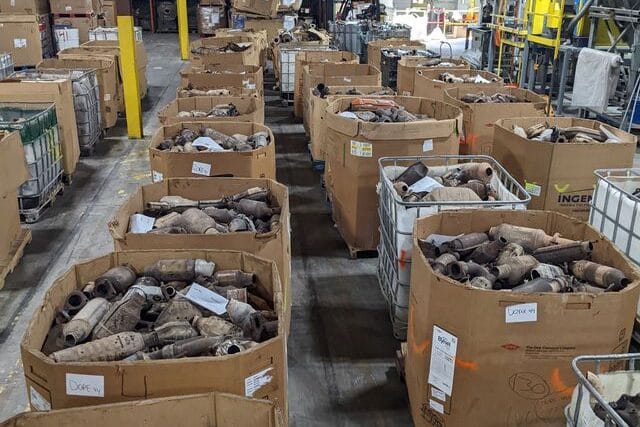
Stories like this show up on local news broadcasts across the country every week, and the reason has nothing to do with luck or bad neighborhoods specifically — it comes down to chemistry. Every catalytic converter contains small amounts of platinum, palladium, and rhodium, three metals that scrap buyers pay real money for and that are cheaper to pull from a stolen exhaust part than to mine and refine from raw ore. Rhodium alone spiked above $20,000 an ounce in 2021, and even after cooling off in the years since, it still trades for several times the price of gold. Platinum and palladium move in similar territory, usually somewhere between $900 and $1,400 an ounce depending on the year, which is enough on its own to make the metal worth extracting even without rhodium in the mix. That's why a part that costs a few hundred dollars to manufacture can put $50 to $300 in a thief's pocket at a scrap yard, and why the job is worth doing even when it takes less time than parking the car would. None of this is news to organized scrap-metal rings, who track precious metal prices the same way commodity traders do and time their runs accordingly.
Why this crime refuses to go away
Under two minutes. That's how long a practiced thief needs with a cordless reciprocating saw and a vehicle sitting at a decent height off the ground.
Unlike stealing a car radio or a catalytic converter's cousin crimes, there's no ignition to hotwire, no alarm to disable in most vehicles built before the last few years, and no need to even open a door. The thief slides underneath, makes two cuts, and is back in a getaway car before anyone in a parking lot notices more than an odd scraping sound. Scrap buyers rarely ask hard questions about where a bare converter came from, which keeps the resale pipeline open even in cities that have cracked down on other forms of street theft. Some rings work parking lots at hospitals and shopping centers systematically, hitting a dozen vehicles in a single night shift before dawn.
Which vehicles thieves actually target
Not every car is equally at risk, and the pattern surprises people who assume expensive cars draw the most attention. Hybrids top the list nationally, with the Toyota Prius consistently named by insurers and police departments as the single most targeted model in the country. The reason is almost funny in a grim way: because a hybrid's gasoline engine runs less often than a standard engine, its converter sees less exhaust heat and corrosion over the years, which leaves more usable precious metal inside it by the time a thief gets there. Add a low, easy-access ride height and you get a vehicle that practically advertises itself.
Full-size pickups and SUVs are the second major category, for the opposite reason — ground clearance. A Ford F-250, a Chevrolet Silverado, or a Honda Element sits high enough that a thief with a jack, or sometimes no jack at all, can slide underneath in seconds without needing to lift the vehicle first. Trucks with dual exhaust systems are worth even more per theft, since two converters mean double the payout for the same two minutes of work. If you drive one of these vehicles and park in the same open lot every day, you are, statistically, near the top of somebody's list.
What actually stops a theft in progress
A welded steel shield or cage around the converter is the closest thing to a real deterrent that exists right now, and it works by turning a two-minute job into a fifteen-minute one that most thieves simply won't attempt in a public lot. Brands like CatClamp and MillerCat sell kits designed for specific makes and models, typically running $150 to $400 including installation at a muffler shop. Skip the generic universal cable wrap sold for under $50 online — it slows almost nothing down and gives you a false sense of security that isn't worth the price tag.
VIN etching is the second layer, and it deserves an honest caveat: it does not stop the theft itself. It only makes the stolen part traceable and harder to sell once it's already gone, since a scrap yard that scans for etched serial numbers can flag it and refuse the sale, and police can match a recovered converter back to your car. A thief who has no working relationship with a scrap buyer and just wants the part gone might cut it loose and dump it anyway, etched number ignored, so treat this as a recovery aid rather than a lock. Some departments and dealerships run free or low-cost etching events — check with your local police non-emergency line or a AAA branch office before paying a shop the usual $20 to $50 rate. Get the shield installed first. Etching is worth doing too, but only after the mechanical barrier is in place.
A tilt or vibration sensor wired into your existing alarm system is worth adding if your car already has one, since most factory alarms only trigger on door or window intrusion and won't notice someone working underneath the frame. Combine that with parking under a working streetlight or inside a garage whenever you can, and you've closed off the three things a thief actually needs: quiet, low visibility, and enough time to finish the cut.
Where you park matters more than most people think
Overnight street parking in a residential area with no cameras is the highest-risk scenario, followed closely by long-term airport and hospital lots where a vehicle sits untouched for days. Renters and apartment dwellers without assigned garage space face a genuinely harder problem here, since there's often no low-cost fix beyond choosing a spot under a light and near foot traffic rather than in a dark corner near the fence line. If your building's management company has any pull with local security patrols, it's worth asking whether a patrol route can be adjusted to pass through the lot more than once overnight — a request that costs nothing and occasionally gets results.
Insurance, state law, and what happens after
Comprehensive coverage, not liability or collision, is what pays out for catalytic converter theft, and most policies include it without an extra rider — but check your deductible before you assume a claim is worth filing. A $500 or $1,000 deductible against a $1,000 to $2,500 replacement bill for a sedan, or north of $3,000 for a truck with dual converters, sometimes makes the math a wash. Filing the claim anyway is usually still the right call if the repair cost clears your deductible by a meaningful margin, and most carriers, including State Farm and Allstate, won't hike your premium sharply for a single theft claim the way they might for an at-fault accident.
State law has started catching up on the supply side of this problem. California's SB 986, passed in 2022, requires scrap metal recyclers to record a seller's identification and vehicle details before buying a bare catalytic converter and to hold the part for a waiting period before it can be resold or shredded — a model several other states, including Texas and New York, have since adopted in some form. At the federal level, the PART Act, which would require automakers to stamp a traceable VIN into every new converter at the factory, has been introduced in Congress more than once without becoming law. Until that changes, or unless your state has closed the recordkeeping gap, the shield on your exhaust pipe is doing more real work than any law on the books.
If it already happened to you
File a police report before you call your insurer, even though it feels like a formality that won't lead anywhere — the report number is usually required to open a comprehensive claim, and it's the only paper trail that connects a recovered part back to your car if a shop or scrap yard flags an etched serial number down the road. Get a tow or a ride rather than driving on a cut exhaust pipe; beyond the noise, an open exhaust system routes carbon monoxide differently than it's designed to, and running it that way for even a short trip isn't worth the risk to save an hour.
Once the replacement converter is installed, that's the moment to add the shield you skipped the first time around. Thieves do return to the same lots, and a car that's already been hit once, with a brand-new part underneath and no added protection, is sitting there again exactly as it was the night before.