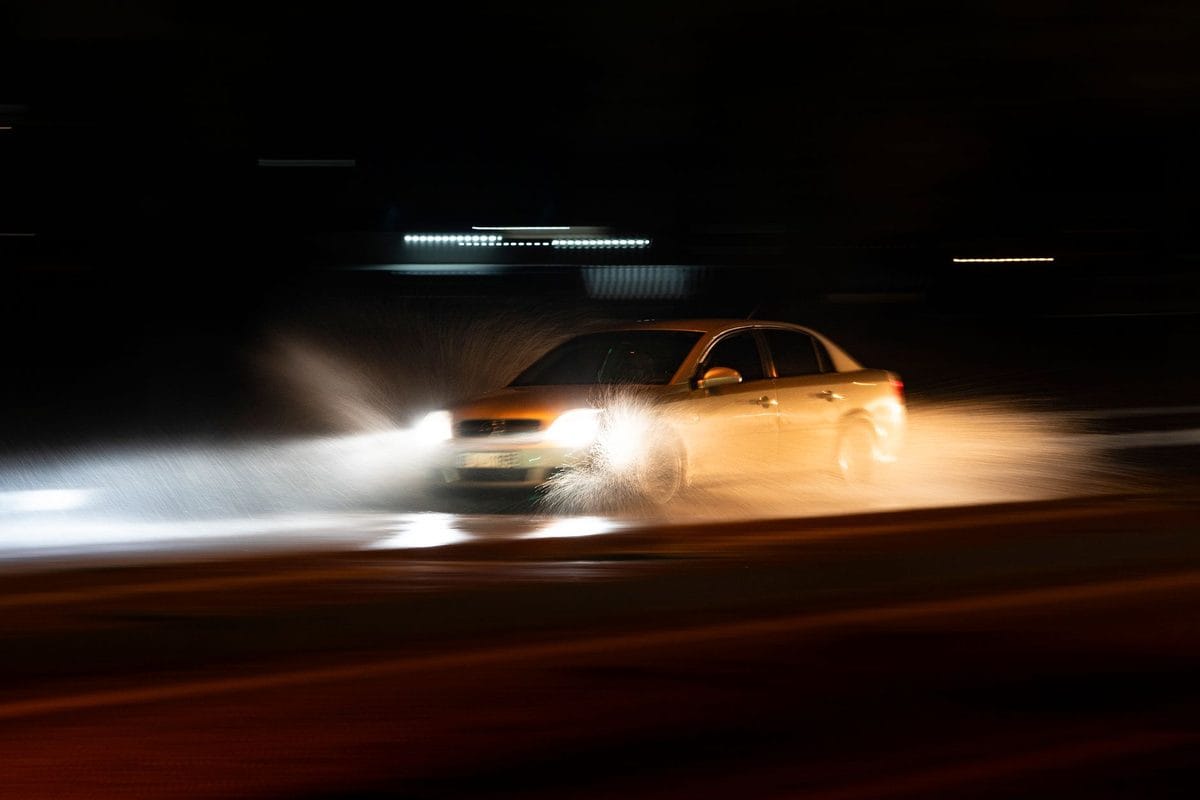
Daylight saving time ends on Sunday, November 1, 2026, when clocks go back from 2 a.m. to 1 a.m., according to NIST. For most of the country the sun will set an hour earlier on the clock, and the first weekday commute home in full darkness tends to arrive before anyone has planned for it. The clock change itself is harmless. What catches drivers is that headlights which looked fine in July can feel very different on a wet road at 6 p.m. in November.
Why the Dark Hours Carry More Risk
Night driving is not just harder on the eyes. It is where a large share of the serious crashes happen. The Insurance Institute for Highway Safety reports that about half of traffic deaths occur either in the dark or at dawn and dusk. Visibility gets worse for everyone on the road, but the people who pay the most for it are often the ones on foot. NHTSA's pedestrian safety guide, citing a 2020 analysis, reports that 76 percent of pedestrians killed in collisions died in crashes that happened in the dark, with another 4 percent at dusk or dawn. The agency counted 7,080 pedestrians killed nationwide in 2024.
Those are national totals, and they cannot tell you which unlit stretch near your house deserves the most attention. They do point to where to focus in October: the evening commute, residential streets without streetlights, and any road where people walk along the shoulder.
What the Headlight Ratings Actually Measure
The IIHS began rating headlights in 2016, and progress has been real but uneven. Of the more than 80 headlight systems available on the 31 midsize cars evaluated that first year, only one earned a good rating. For model year 2026, the institute reports that 46 percent of tested headlight systems earn a good rating, while about 17 percent are rated marginal or poor because they provide inadequate visibility, excessive glare for oncoming drivers, or both. Glare counts against a headlight, so a brighter beam is not automatically a better one. A system that blinds the car coming the other way can lose points that a dimmer, well-aimed system keeps. The ratings describe the headlights as the automaker sold them on that model year. Swap the bulbs or let the lens yellow, and you are driving a different system from the one IIHS tested.
The crash numbers give the ratings their weight. Using police-reported crashes and controlling for miles driven and other factors, IIHS links vehicles with good-rated headlights to 19 percent fewer nighttime single-vehicle crashes and 23 percent fewer nighttime pedestrian crashes than vehicles with poor-rated headlights. Acceptable and marginal ratings are associated with reductions of about 15 percent and 10 percent in nighttime single-vehicle crashes. These are associations, not guarantees for a single car, but they are consistent enough to matter when you shop.
If you are car shopping this fall, look up the IIHS headlight rating for the exact model year before you compare paint colors. A good rating is a visibility upgrade you get without paying for an accessory, because it is already designed into the car.
Glare Gets the Blame, but Rarely the Crash
Glare is annoying, but it shows up in only a sliver of nighttime crashes.
IIHS reports that glare is a contributing factor in only one or two of every 1,000 nighttime crashes, which makes it a much smaller problem than inadequate visibility. An IIHS study published in October 2025 found that this share has hardly changed over the past decade. Automakers have responded: the institute says only 5 percent of headlight systems tested on model year 2026 vehicles had excessive glare, compared with 21 percent for model year 2017. That does not make glare harmless. It means the bigger safety gain comes from seeing the road better, not from turning everything down. The habit that matters is simple: switch to low beams when oncoming traffic appears, and drop them when you are following another car closely.
High Beams Are the Most Underused Tool You Own
On a dark, empty road, high beams can show an obstacle far sooner than low beams. A study by IIHS and University of Michigan Transportation Research Institute researchers, covering drivers in and around Ann Arbor, Michigan, found that only 18 percent of drivers who were isolated enough to use high beams actually did. The institute's worked example makes the gap concrete: a driver of a 2024 Subaru Solterra should be able to spot an obstacle in the left lane 202 feet ahead on low beams and 533 feet ahead on high beams.
Drivers hold back for a few reasons. They forget, they are unsure whether oncoming traffic is far enough away, or they underestimate how much the high beams change what they can see. Each of those problems has a fix. Use high beams on a rural road with no other traffic in sight, and drop to low beams as soon as another car's lights appear ahead or you come up behind a vehicle.
Features Your Car May Already Have
Several lighting features now appear on new cars, and it helps to know which ones your vehicle has before you decide it needs a fix. High-beam assist uses a camera to switch between high and low beams depending on whether other vehicles are present, and the driver can still switch manually. A study by researchers from the University of Michigan and General Motors found that GM's high-beam assist was associated with fewer nighttime crashes, which makes it one of the few real-world results on this feature.
Curve-adaptive headlights pivot in the direction of steering, so a bend lights up before you reach it. In one volunteer experiment, curve-adaptive HID lights let drivers spot a hard-to-see object on a dark, curvy road about one-third of a second earlier than fixed headlights. Insurance claim data points the same way. The Highway Loss Data Institute found that nighttime collision and property damage liability claim rates were 10 percent and 15 percent lower for 2010 Mazda 3 models with curve-adaptive HID lighting than for those with standard halogen lamps, and daytime claims were unaffected.
Adaptive driving beams are the newest step. They keep the high beams on and cut a shadow around other vehicles, so the road stays lit while the drivers ahead and oncoming are spared the glare. NHTSA amended its rules in 2022 to allow these systems on vehicles sold in the United States. IIHS notes that the U.S. rules restrict how the systems can work, and only a few manufacturers offer them so far. If you are shopping, check the feature list rather than assuming a new car has them.
How Far Your Low Beams Actually Reach
IIHS judges headlights against test targets placed in the road ahead, including a pedestrian-sized target at 140 feet and a deer-sized target at 220 feet. Those distances come from the test, not from a driving rule, and the test does not tell you how fast to drive. What it does show is how much of the road your low beams actually light up. That is the number to keep in mind when you pick a speed on an unlit county road, where the first warning may be the animal itself.
A Ten-Minute Visibility Check Before the Clocks Change
Most of the common problems show up in a driveway, at night, with the car parked facing a garage door or a wall that reflects the light. Turn on the low beams, walk around the car, and then check the view from the driver's seat. Work through these five items:
- Both low beams and both high beams light up. A pair that doesn't match looks wrong on the road, and replacing bulbs in pairs keeps the beams even.
- The lenses are clear. A cloudy or yellowed lens scatters light into a haze in front of the car, and that haze gets worse on wet pavement.
- The beam lands on the road ahead, not on the treeline or the oncoming lane. If the light sits high, the aim is off, and a shop can adjust it.
- The wiper blades clear the glass without streaks. Streaks break up oncoming headlights, which makes a dark road harder to read.
- The inside of the windshield is clean. A film from the dashboard or the defroster vents can turn every oncoming headlight into a glare patch, and cleaning the glass costs nothing.
Run the check this weekend, not on the first dark Tuesday. If a beam is weak, you will find out in daylight in your own driveway, instead of on a wet county road at 6 p.m. with the first cold rain of the season coming down.