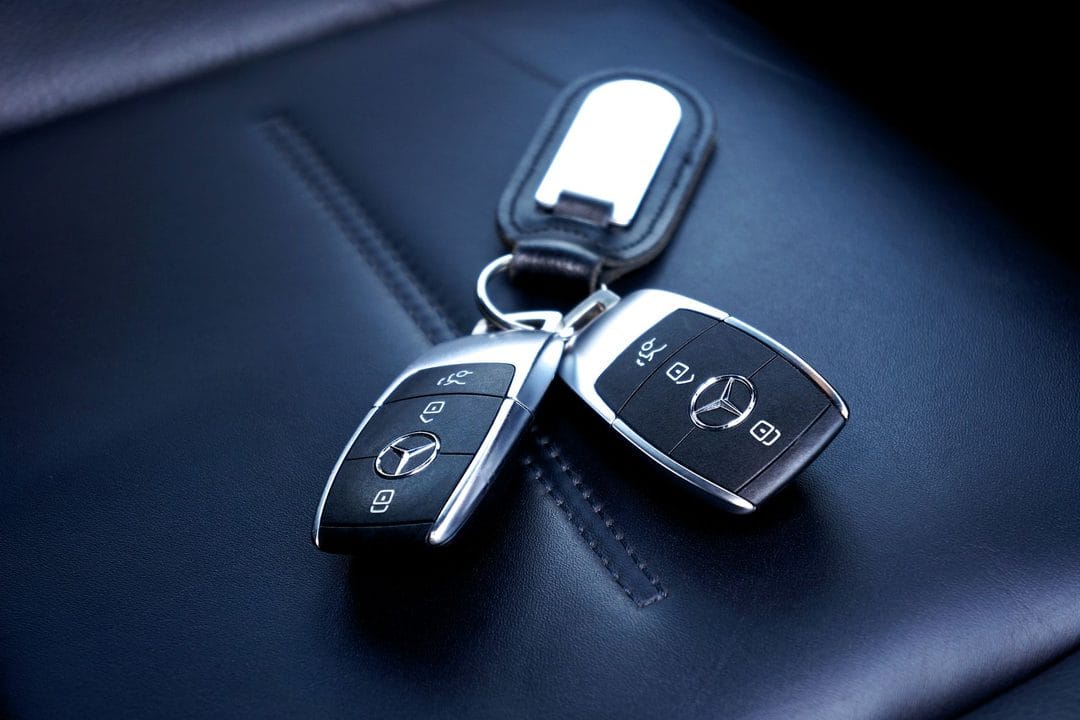
Your key fob is sitting on the hook by the front door, twenty feet from the driveway. Overnight, two people with a pair of cheap radios stand next to your house, and by morning your car is gone. No broken glass, no alarm. That is a relay attack, and it has been one of the most frustrating kinds of car theft for keyless-entry owners for years.
How the relay works
Passive-entry systems assume that if the fob is close to the car, the driver must be close too. The car sends a low-frequency request signal from its door handles and bumper, and the fob answers when it hears it. A relay attack exploits that handshake. One thief stands near the house, where the fob is, and a second stands at the car. Each carries a device that picks up the signal and passes it along, so the car believes the real key is standing next to it. The whole exchange takes a fraction of a second, which is why the car unlocks and starts without any alarm going off.
The gear is not exotic. Commercial relay kits circulate online, and the thieves who use them are usually after a specific model they can sell quickly rather than a random car. That matters for your risk: a popular truck or an SUV in demand overseas is a more likely target than a ten-year-old sedan nobody wants. Range matters too. A fob sitting in a kitchen two rooms back can still be reached from a driveway, and a garage with an open side door does not protect it as much as people expect.
Step one: put the fob in a Faraday pouch
A Faraday pouch is a fabric or metal-lined sleeve that blocks radio signals. Keep the fob inside it at home, and the relay has nothing to pick up. Pouches cost roughly $10 to $30 at electronics or auto parts stores, and they are the cheapest fix on this list. I would buy one before anything else.
The catch is convenience. Every time you walk out with the fob in your pocket, the pouch has to come out too, and people forget. Pouches also do nothing if your car will still start with a fob in a bag on the seat. So treat the pouch as a habit, not a setting.
Step two: turn off passive entry where you can
Many current models let you disable passive entry or the walk-away lock in the vehicle settings menu. On some vehicles you can keep the fob for remote lock and unlock but require a press of the start button with the fob in hand. That still allows a relay in theory, but it removes the drive-away-without-a-key trick. Check your owner's manual or the infotainment settings before you assume it is possible. If you cannot find the option, that itself is worth a question at the dealer.
Step three: a physical deterrent that works without electronics
A steering wheel lock such as The Club costs roughly $40 to $100 and does not depend on any signal. It will not stop a thief who tows the car, but relay thieves want a car they can drive off in minutes, and a locked wheel adds a delay they do not want. I think a visible bar is one of the better values on this list, partly because it works against every theft method at once, not just relays.
A kill switch or a hidden fuel cut-off is a different tool. Installed by a competent shop, it can stop the engine from starting, but it needs a legitimate installer and it can cause problems if it is poorly wired. Do not buy the cheapest one online.
What about the OBD port?
Some thieves do not bother with relays at all. They plug a device into the diagnostic port under the dashboard and program a new fob, or they pull key data over the cable. A small locking cover for the OBD port costs very little and blocks that route. It is an unglamorous fix, and it is the one I would leave for last, because it helps only with one attack.
The key replacement bill is the real motivation
Replacing a lost or stolen smart key through a dealer often runs into several hundred dollars, and some models need the car programmed in the shop. If your car is stolen and the key is gone too, the insurance claim covers the vehicle, but the replacement key and reprogramming may land on your deductible. That is one reason to take the cheap steps even on an older car.
If you lose the only spare, an automotive locksmith is often cheaper than the dealer, but not every locksmith can program your model. Ask before you book, and bring proof of ownership, because most will not program a key without it.
Your insurer may also offer a small discount for anti-theft devices. Ask before you buy, because some insurers only credit a device they have listed, and a discount of a few percent does not repay a $300 steering lock by itself.
If the car is already gone
Call the police first, then your insurer. Have the VIN, plate number and a recent photo of the car ready. The police report is what the insurer will ask for, and a clear note of when you last saw the car and when you noticed it gone shortens the claim. If the car has a connected-services app from its manufacturer, check it straight away, because many systems can report a last known location or lock and unlock the car remotely.
Do not try to recover the car yourself, and do not confront anyone who is near it. Relay thieves usually move a car within hours, and a stolen car in another county is a police matter, not a weekend project. Keep the receipts for any towing, rental car or key replacement, because comprehensive coverage may pay some of them depending on your policy. Read the theft section of your policy, since insurers differ on how they treat keys and security devices, and a missing or unprogrammed spare key can change what gets paid.
Cars that come back often need the steering column, the body control module or the key system replaced, and the insurer will want a repair estimate before the claim closes. Treat the first week as paperwork and the second as the time to close the security gap that let it happen.
A short checklist
- Buy a Faraday pouch this week and use it every night.
- Check the settings for passive entry or walk-away lock options.
- Add a visible steering wheel lock if the car sits outside.
- Cover the OBD port if the car is a popular target model, or if you park on the street.
- Keep one spare key somewhere other than the entryway hook, because a quick grab is the whole plan for a thief.
Where the advice gets murky
Not every relay defence is equal, and manufacturers keep changing their systems. Some newer cars add motion sensors, or a timeout that stops the car from unlocking after the fob has been silent for a while. Others have received software updates that tighten signal checks. None of that is guaranteed on your car, so ask the dealer what your model year has, and do not assume a newer car is automatically safe.
There is also a real trade-off. A pouch and a wheel lock add friction to the morning routine, and friction is exactly what gets skipped on the busy days. The best setup is the one you will still be using in February.
Parking in a locked garage remains the strongest step against any theft method, and it costs nothing if you already have the space. If you do not, the combination above is a reasonable substitute, and it is far cheaper than replacing the car.