Livingston, New Jersey, has a name for October and November: car fire season. Fire Chief Chris Mullin told Patch in 2021 that the town used to lose three or four cars a year to fires that started under parked vehicles. The cause was nothing more exotic than the leaf piles residents leave at the curb for pickup. Awareness has pushed the number down, he said, but the mechanism hasn't changed. A hot exhaust, a heap of dry leaves, and a car parked in the wrong spot.
Fire is the dramatic way leaves go after a car, and it's also the rarest. The common ways are quieter and, on a bad day, more expensive: the drains that carry rain out of your car clog up, and the road itself turns slick. Each one has a fix that takes about ten minutes.
Why a Parked Car and a Leaf Pile Don't Mix
An exhaust system runs hotter than most drivers imagine. An EPA fact sheet from the early 1980s, still posted on the Texas Commission on Environmental Quality's website, puts the outside metal of a catalytic converter at roughly 800 to 1,000°F under extreme engine load. When a failed spark plug or ignition wire leaves the engine misfiring, it can reach 1,200 to 1,400°F. Fire departments disagree on exactly when dry leaves ignite. Stamford, Connecticut, says around 300°F, and that a surface at about 750°F can start a fire in as little as three minutes, while the fire department in Ramsey, New Jersey, cites a figure of 575°F. A misfiring converter at 1,200°F is past either number, and so is a healthy one working hard. The converter also holds its heat, because the EPA notes it takes longer to cool than the rest of the exhaust, and the Ramsey department puts the cool-down for a hot exhaust at about ten minutes. The risky window opens the moment you park, when that hot metal sits motionless over whatever has drifted beneath it.
Keep the risk in proportion, though. Carmakers design against this with heat shields and insulation, and the same EPA sheet says most of the fires it reviewed involved an engine that was already running badly or undercoating sprayed onto exhaust parts. Ramsey's fire department puts a typical exhaust at around 400°F and a misfire at around 800°F, so a healthy engine with a clean underside is a far lower risk than a car with a flashing check engine light. Damp leaves aren't a safe harbor either: Stamford's fire department notes that wet piles can dry out in minutes during a dry spell. And a battery-electric car has no catalytic converter, although a hybrid still does.
Park on bare pavement. If the curb is lined with piles, drive past them and take the longer walk, and never nose into a pile at the end of a driveway. After you drive through dry brush or a deep drift of leaves, look under the car for debris stuck to the exhaust, and let everything cool before you pull it off, which is the North Carolina Forest Service's advice. The same agency recommends keeping a fire extinguisher in the vehicle, and that costs less than a deductible.
The Drain at the Base of Your Windshield
Your car has a gutter system, and by November it is usually full of leaves.
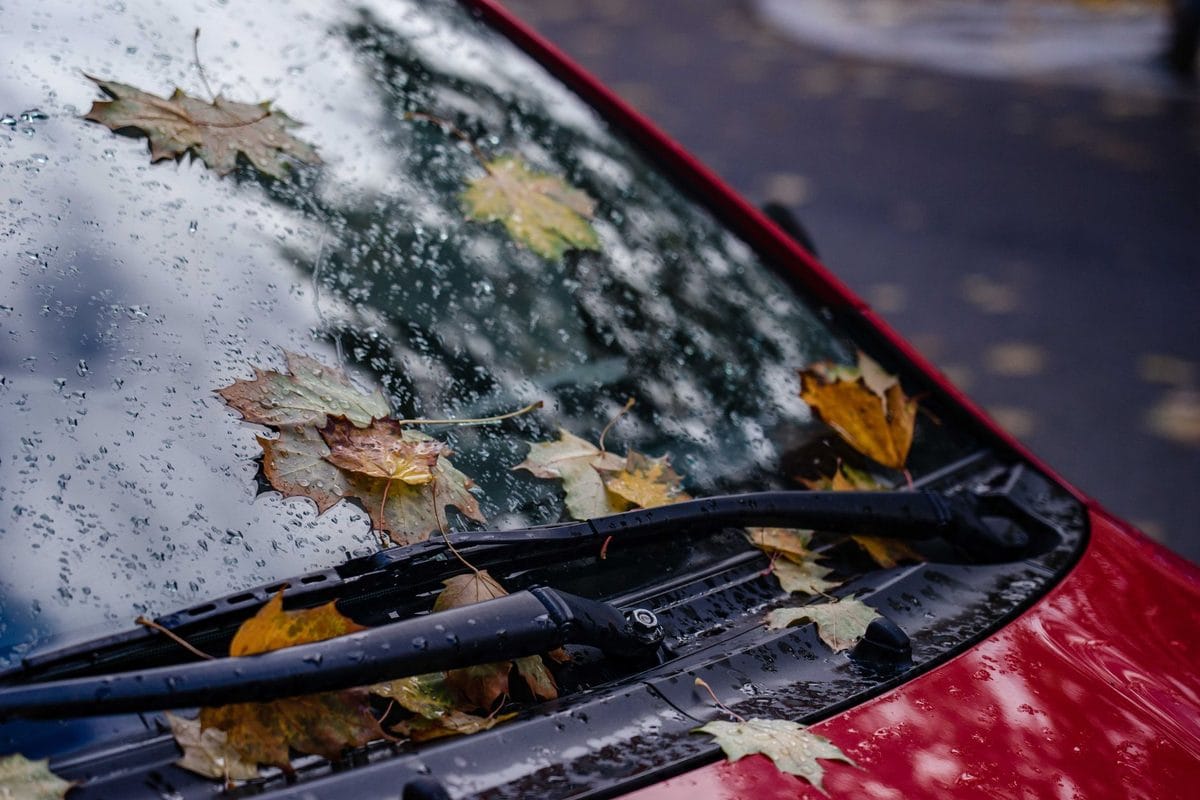
The cowl is the panel under the wiper arms where the hood meets the glass, and on many cars it doubles as the fresh-air intake for the heater and A/C. Rain that lands there is supposed to run out through drains that exit in the engine bay or behind the fenders. When leaves, pine needles, and grit pack the channel, water backs up and goes looking for another way in, typically through the HVAC intake and into the footwell. FCP Euro's technical guide explains why that matters: on many vehicles the computers and control modules sit under the carpet in the passenger footwell and under the front seats, which is exactly where the water pools. A leak that starts as a damp floor mat can end as a dead module, and replacing electronics costs far more than clearing a drain. The warning signs are a carpet that is damp after rain or a car wash with no door leak to explain it, a musty smell, and windows that fog up and stay that way.
The check takes less time than a coffee. Pop the hood, look at the base of the windshield under the plastic cover, and scoop out the leaves by hand or with a shop vacuum. Then pour a small amount of water along the channel and watch for it to come out low in the engine bay or behind the front wheels. If it pools instead, the drain is still blocked.
Do this at the start of leaf drop and again when the trees are bare. If the car sleeps under a tree, FCP Euro's writers suggest a look every week, which is less extreme than it sounds when wet leaves are landing on the cowl every day. Be aware that on some cars the drains sit behind the fender liner, so a thorough job means pulling the liner. That is where a shop earns its fee.
Sunroof Drains: Four Small Tubes, One Expensive Surprise
A sunroof is not watertight, and the engineers know it. A tray around the opening catches whatever gets past the seal, and a drain at each corner sends that water through tubes in the pillars and out beneath the car. Leaves and pine needles collect in the tray, the tubes narrow, and the overflow runs into the headliner or down the A-pillars. The symptom usually appears somewhere lower than the cause, such as a damp rear carpet, a stained corner of the headliner, or a sloshing sound from inside a pillar. A front-drain clog tends to show up near the front footwells, and a rear-drain clog tends to wet the back carpet or the cargo area. Cars without a sunroof can skip this section; the cowl and the parking advice still apply.
Open the roof, vacuum the loose debris out of the tray, and pour a little water into each corner while you watch for it to exit under the car. For a stubborn clog, feed plastic trimmer line gently into the drain, and never use metal wire or a coat hanger, which can puncture a tube. The guides disagree on compressed air: FCP Euro says it can clear a blockage but warns that the tubes are often multi-piece and can separate inside the body, and another mechanic-written guide limits it to low pressure and short bursts. Keep the high-pressure air in the garage. A separated tube sends water straight into the headliner, and that is a far bigger job than the clog you started with.
A shop cleaning typically runs somewhere around $100 to $300 depending on the car and whether trim has to come off, while the do-it-yourself supplies come to roughly $10 to $40. If you've owned the car for years and never touched the drains, pay for the cleaning once before the rainy season.
Slick Pavement and What Hides Under It
Wet leaves can be as slick as ice, according to a fall-driving bulletin the Washington State Department of Enterprise Services sent to its fleet drivers on September 23, 2026. The same bulletin points out that dry leaves hide potholes, curbs, and lane markings. Treat a leaf-covered street as a wet street at best, and slow down before you can see what is under the leaves.
Do your braking before you reach the leaves, not on them, and steer with small, smooth inputs. If the ABS pulses under your foot, that is the system doing its job, so keep pressure on the pedal and keep steering. Leave extra room behind the car in front, and don't drive through big piles for fun. The state bulletin warns that children and animals can be hiding in them, and a drift of dry leaves can leave a clump lodged against your own exhaust.
Tires matter more than anything else on this list. The bulletin calls tread below 2/32 of an inch unsafe, which is the legal minimum in most states and a floor rather than a target. A tire that is legal but nearly bald will be the first thing to let you down on a wet street full of leaves.
A Ten-Minute Leaf-Season Routine
None of this needs special tools. Pick a dry afternoon and work through the list:
- Park on bare pavement, not on or beside a leaf pile.
- Clear the cowl at the base of the windshield, pour a little water through, and confirm that it comes out underneath.
- If you have a sunroof, open it, vacuum the tray, and run the same water test at every corner.
- Pull the leaves out of the wiper area and off the vents. The Washington bulletin also lists the radiator and the strip between the hood and windshield, to head off mold, water damage, and mechanical trouble.
- After the first hard rain, peel back the passenger-side floor mat and press the carpet underneath with your palm.
That last check is the one to remember. It takes ten seconds, and a wet palm means the water came from somewhere above, whether a cowl, a sunroof corner, or a door seal. Dry the carpet and track down the source that same week, while the repair is still a drain cleaning and not an electrical diagnosis.