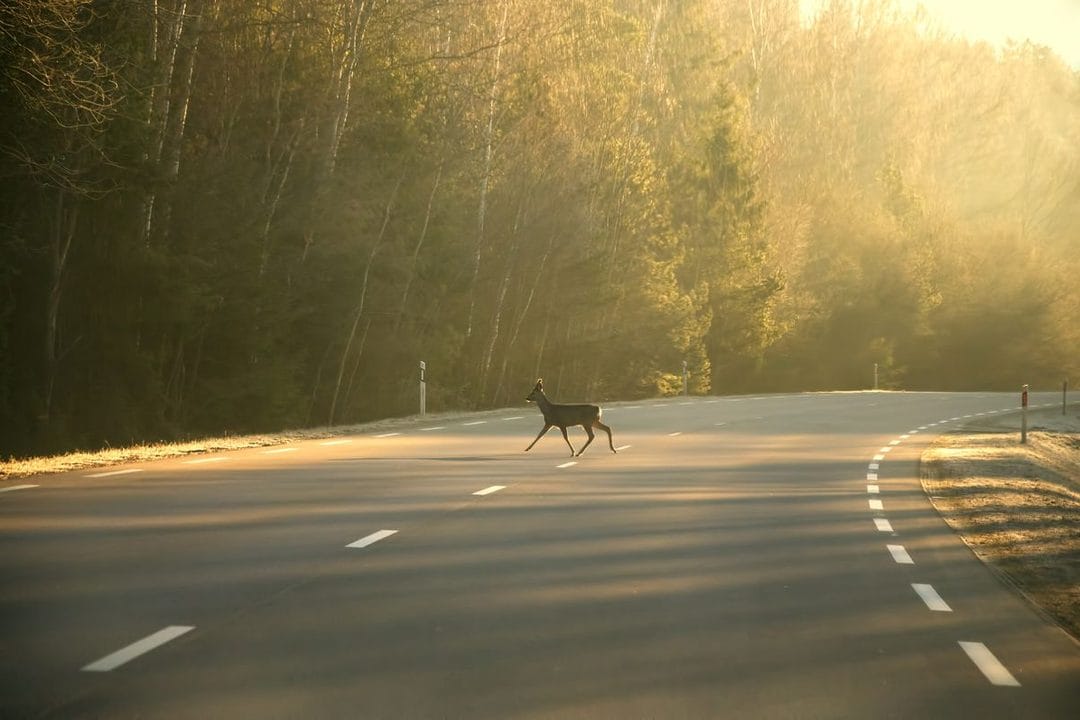
Two and a half million deer-vehicle collisions happen every year in the United States, and roughly half of them are packed into a ten-week window between mid-October and the end of December. State Farm's annual claims data — the closest thing this problem has to a national scoreboard — puts the average cost of one of these claims at $4,596, and that number has climbed every year since 2021 as headlight assemblies, radar sensors, and windshield-mounted cameras turned a simple bumper repair into a four-figure electronics job. If you drive through rural or wooded stretches of the country between now and Thanksgiving, the odds of one of those collisions involving your car are higher than they'll be at any other point in 2026.
The spike isn't random, and it isn't really about deer being more careless in the fall. It's about biology lining up with the clock in a way that puts more deer near more roads at exactly the moments when drivers can see the least.
Why October and November Are Different
White-tailed deer enter their rut — the breeding season — in late October and peak through mid-November across most of the country. Bucks that spend ten months a year being cautious and mostly nocturnal start moving constantly and carelessly during the rut, chasing does across open ground, through yards, and across roads without the usual pause-and-look behavior. Does, meanwhile, are pushing yearlings out of established territory right around the same weeks, which means young, inexperienced deer are also wandering into unfamiliar road corridors for the first time. Layer daylight saving time on top of that — clocks fall back in early November, and suddenly the evening commute that used to end in daylight now ends in the exact blue-gray dusk when deer are most active — and you get a collision curve that spikes hard for about eight weeks and then drops off almost as fast as it rose.
State Farm's state-by-state odds ranking tells the geography part of the story clearly. West Virginia has topped the list for over a decade, with roughly 1-in-38 odds that a given driver there will hit a deer within a year. Montana, Pennsylvania, Michigan, and Wisconsin round out the next tier, each sitting somewhere around 1-in-45 to 1-in-55. The national average is closer to 1-in-127, which sounds reassuring until you remember it's an average across states like Nevada and Hawaii that barely register — if you actually live or drive through Pennsylvania's Allegheny corridor or rural Wisconsin dairy country, your real exposure looks a lot more like West Virginia's number than the national one.
What Your Insurance Actually Pays For
This is where a lot of drivers get a surprise at the worst possible moment. Hitting a deer outright — the animal runs into your car, or you run into it, with no other vehicle or object involved — is a comprehensive claim, not a collision claim. That distinction matters because plenty of drivers carry liability-only coverage and assume "insurance" covers this kind of thing broadly. It doesn't, unless comprehensive is specifically on the policy, and comprehensive is optional on every state's minimum-coverage requirements. If you swerve to avoid the deer and hit a guardrail, a tree, or another car instead, that becomes a collision claim, which is a different coverage line with its own deductible and often a bigger dent in your premium at renewal.
Insurance Institute for Highway Safety data attributes roughly 200 deaths a year in the U.S. to animal-vehicle crashes, and the overwhelming majority of those fatalities come from the swerve, not the impact with the deer itself. A 3,500-pound sedan hitting a 150-pound deer at 55 mph is a bad repair bill. That same sedan swerving into the oncoming lane, a tree, or a rollover to avoid the deer is how people actually get killed in these crashes. Motorcyclists carry a disproportionate share of the fatality numbers for the obvious reason that there's no crumple zone between the rider and either the animal or the pavement.
The Defensive Driving Tactics That Actually Help
Don't swerve.
That's the single piece of advice every state trooper, insurance adjuster, and defensive-driving instructor repeats every October, and drivers ignore it every October, because the instinct to avoid hitting something is almost impossible to override in the half-second you get. Hold the wheel straight, brake as hard as you can in a straight line, and accept the deer strike if the alternative is leaving your lane. A deer strike at reduced speed is a repair bill; an oncoming-lane swerve at 55 mph is a different category of event entirely.
A few tactics genuinely move the needle beyond that one rule. Deer rarely travel alone in the fall — if you see one cross, assume two or three more are behind it and slow down accordingly before you're already past the first one. Deer-crossing signs aren't decorative; they mark documented collision corridors based on actual DOT crash data, not a generic guess, so treat them as a real speed-reduction cue rather than background scenery. High beams extend your reaction window dramatically on unlit rural roads — deer eyes reflect light back at you well before their bodies are visible in low beams, and that extra second and a half of warning is often the entire difference between braking and impact. Scan the shoulders, not just the lane ahead, especially where tree lines or cornfields meet the road edge, since that's where deer step out from cover with zero warning.
- Slow down 5–10 mph below the posted limit at dawn and dusk on rural two-lanes between October and December — this is the single highest-leverage change most drivers can make and costs nothing.
- Use high beams whenever there's no oncoming traffic; the added reflection range from a deer's eyes buys real reaction time.
- Treat deer-crossing signage as a genuine hazard marker, not landscaping, since it's placed against actual crash history.
- If you spot one deer, expect more nearby, and cover the brake rather than staying on the accelerator.
- Some drivers swear by deer whistles mounted on the bumper, though independent testing from the Insurance Institute for Highway Safety and university studies has never found consistent evidence they reduce strikes — treat them as a placebo at best, not a substitute for slowing down.
If You Hit One Anyway
Pull over as soon as it's safe and turn on your hazards — a disabled car on the shoulder after a deer strike is itself a secondary collision risk, and a meaningful number of injuries in these incidents happen from the vehicle stopped afterward, not the initial impact. Do not approach the deer if it's still alive; an injured, panicked animal weighing over a hundred pounds with sharp hooves can cause a serious injury to someone trying to help it, and most states actually prohibit moving or handling wildlife carcasses without a permit anyway. Call the police or your state's non-emergency line to file a report — you'll need that report number for the insurance claim regardless of how minor the damage looks, and it also gets the carcass flagged for removal before it becomes a hazard for the next driver.
Photograph the damage before you leave the scene if you can do it safely, and photograph the deer's position relative to your vehicle if it's visible — insurers sometimes push back on comprehensive-versus-collision classification when the accident narrative is vague, and a couple of photos settle that argument before it starts. File the comprehensive claim the same day if you can; adjusters process fall deer claims faster when there's an active queue for exactly this reason, and a same-day filing usually means a same-week estimate. Check your headlight and radar sensor housing even if the damage looks purely cosmetic — a growing number of 2024 and newer vehicles route adaptive cruise and automatic emergency braking sensors through the front fascia, and a cracked housing there can throw a fault code that a body shop won't catch on a visual walk-around.
The Cost Side Nobody Budgets For
Most drivers picture a deer strike as a bent hood and a cracked headlight — and on a 2005 Corolla, that's roughly what it is, often $1,500 to $2,500 at an independent shop. On anything built in the last five years with forward radar, a windshield-mounted camera for lane-keeping, or LED matrix headlights, the number changes fast. Radar recalibration alone runs $200 to $600 depending on the shop and the brand, and that's before any body panel work. A full front-end rebuild on a vehicle with adaptive headlights and a damaged radar module has pushed past $8,000 on some late-model SUVs — which is exactly why comprehensive coverage with a reasonable deductible matters more this decade than it did when the same crash was a $2,000 fender job.
None of this means treating every rural drive between now and December as a hazard course. It means adjusting your speed and your headlight habits for about eight weeks a year, in the specific hours around dawn and dusk, on the specific roads where tree lines and cornfields meet the pavement — and accepting that if it happens anyway, braking straight is the one decision that keeps a bad afternoon from becoming something much worse.