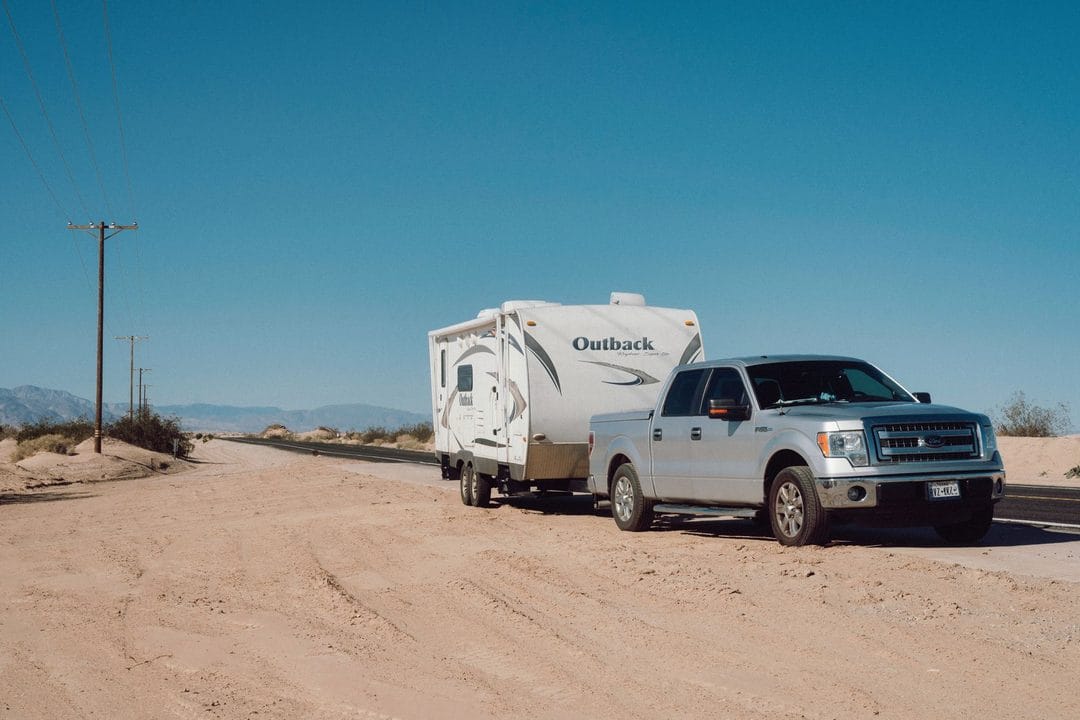
You spent the winter promising yourself the family would actually use the camper this year, and now there's a boat, a 24-foot travel trailer, or a pair of jet skis sitting in the driveway with your name on the registration. The part nobody mentions at the dealership is that the tow rating printed in the brochure and the weight you can safely pull up a grade in July are two very different numbers. Get this wrong and you'll find out the hard way somewhere on I-70 with the transmission temperature light glowing and a line of traffic backing up behind you.
Summer is the worst possible time to learn towing math on the fly. Ambient heat strips margin out of every drivetrain, mountain passes punish anything underpowered, holiday weekends jam the right lane with people doing exactly what you're doing, and a fully loaded trailer behaves nothing like the empty one you backed out of the lot. So before you hitch up for the first long weekend, here's how to figure out what your vehicle can really pull, which gear is worth the money, and where people most reliably get themselves into trouble.
Tow rating is a ceiling, not a target
Every manufacturer publishes a maximum tow rating, and almost everyone misreads it. A 2024 Ford F-150 with the 3.5L EcoBoost and the Max Trailer Tow package is rated up to 13,500 pounds. That headline figure assumes a 150-pound driver, almost nothing else in the cab, the correct hitch hardware, and a trailer with textbook weight distribution. Add three passengers, a packed cooler, a bed full of firewood and a rooftop cargo box, and your real-world capacity drops faster than most people expect.
The number that actually keeps you safe is GCWR, the gross combined weight rating. It's the total of everything: truck, trailer, fuel, people, the dog, and the cooler nobody admits to packing. Subtract your loaded vehicle weight from the GCWR and what's left is the trailer you can legitimately tow. The honest rule of thumb most experienced haulers live by is to stay under 80 percent of the published tow rating. On that F-150, that means treating roughly 10,800 pounds as your real working ceiling, not 13,500. The last 20 percent is reserved for the day you hit a headwind on a 7 percent grade with the air conditioning maxed out.
Tongue weight is the other half of the equation, and it's where stability lives or dies. You want 10 to 15 percent of the trailer's total weight pressing down on the hitch ball. Too little and the trailer starts swaying at highway speed; too much and your front tires go light and the steering turns vague and floaty. A 7,000-pound trailer should put roughly 700 to 1,050 pounds on the ball. Buy a tongue-weight scale (the Sherline runs about $130) and measure it loaded the way you'll actually travel, not empty in the driveway. The difference between those two states is usually a couple hundred pounds and the entire reason a rig that felt fine on the test loop tries to kill you at 70 mph.
Match the vehicle to the trailer, not the brochure
People shop trailers the way they shop sofas, by how it looks parked in the lot. Then they discover their half-ton can technically pull it but hates every minute of doing so. A few honest pairings worth knowing before you sign anything:
- A mid-size truck like the Toyota Tacoma or Chevy Colorado tops out around 6,000 to 7,700 pounds, which comfortably covers a small camper or a single-axle utility trailer but starts sweating under a loaded toy hauler.
- Half-ton trucks, the F-150, Silverado 1500 and Ram 1500, handle most travel trailers and mid-size boats with room to spare, as long as you respect the tongue weight and don't load the bed to its own limit at the same time.
- For a fifth-wheel or anything north of 12,000 pounds, you want a three-quarter-ton diesel such as a Ram 2500 or Ford F-250. This is not the place to stretch a half-ton "because it'll probably be fine for one trip."
- SUVs are the trap most families fall into. A Toyota Highlander is rated for 5,000 pounds, which sounds generous until you realize that covers maybe a small pop-up or a pair of personal watercraft, and nowhere near the 26-foot bunkhouse trailer the salesman gestured at on the way to financing.
Payload is the quiet limit that catches SUV and half-ton owners off guard. Your truck can pull 11,000 pounds, sure, but the door-jamb sticker might only allow 1,600 pounds of payload, and tongue weight counts against that number along with every passenger and bag. Hook up a heavy travel trailer and you can blow past your payload rating while still sitting well under the tow rating. Both limits matter, and the lower one wins.
Towing electric is a different math problem
If you're towing with an EV, throw out your assumptions about range. A Rivian R1T is rated to 11,000 pounds and a Tesla Cybertruck to 11,000 as well, and both will move a heavy trailer without breaking a sweat. The catch is what happens to the battery. Hitch up a tall, boxy travel trailer and watch your range get cut roughly in half. That 300-mile pack effectively becomes a 150-mile pack, and the drag from a flat-fronted camper hurts an EV far more than it hurts a gas truck because there's no engine efficiency curve to fall back on.
The charging logistics are the real headache. Most DC fast-charger stalls are laid out for a single vehicle, not a truck with 30 feet of trailer hanging off the back. You'll often have to unhitch to reach the plug, or block two stalls and feel the glares. Until pull-through charging gets common, the realistic move with a trailer is to plan short legs, charge to 100 percent overnight at the campsite if you can, and treat any EV road trip with a big trailer as a series of 120-mile hops rather than the 300-mile runs you'd plan in a diesel.
The gear that earns its place
A weight-distribution hitch is the single best purchase most towers ignore. It uses spring bars to push load back onto the front axle, leveling the rig and taming sway before it starts. Anything over about 5,000 pounds, or any trailer that makes the truck visibly squat at the rear, needs one. A quality setup from Equal-i-zer or Andersen runs $400 to $700, and it changes how the whole rig drives more than any other single piece of equipment.
Then there's the boring stuff that quietly saves trips:
- A transmission cooler is cheap insurance if your tow vehicle didn't come with the factory tow package, since heat is what kills automatics under load.
- Trailer brakes matter more than people think. Anything over 3,000 pounds legally needs them in most states, and a proportional brake controller like the Tekonsha P3 (around $130) does a far better job than the cheaper time-based units that brake the same whether you're crawling or panic-stopping.
- Buy the trailer tires you actually need: ST-rated (Special Trailer) tires, not repurposed passenger tires, with a load range stamped for your real weight. A blowout on a hot August interstate is almost always an old or underrated tire, not bad luck.
- A tire pressure monitoring system for the trailer itself is worth its weight in aggravation avoided, because you can't feel a slow leak on a trailer axle the way you feel one on a drive wheel.
That last point is the one experienced haulers wish they'd learned sooner. By the time you smell hot rubber from a failing trailer tire, the tire is already gone and it's often taking the fender and wiring with it. A $150 TPMS kit pays for itself the first time it warns you at a gas stop instead of on the shoulder.
Where summer towing actually goes wrong
Heat is the enemy your owner's manual mentions only in the fine print. Towing up a long grade in 95-degree weather can spike transmission and coolant temperatures past anything you'll ever see commuting. Watch the gauges, and if the trans temp starts climbing, drop a gear to keep the RPMs up rather than lugging the engine in top gear. It feels backwards, but lugging a low-RPM engine under load makes more heat, not less. Most modern trucks have a Tow/Haul mode built for exactly this; use it, because it changes shift points and adds engine braking to keep the drivetrain cooler on both the climbs and the descents.
Sway is the failure mode that genuinely scares people, and it almost always traces back to a single mistake: too little tongue weight, or a load packed toward the rear of the trailer. The fix is dull and reliable. Load your heavy items over and slightly ahead of the trailer axle, get your tongue weight into that 10-to-15-percent window, and never try to "drive through" sway by speeding up. If a trailer starts to fishtail, ease off the throttle and apply the trailer brakes manually with the controller; hitting the truck brakes alone often makes the sway worse by pushing the rig from the front.
The other classic mistake is forgetting that a loaded rig stops and turns like an entirely different vehicle. Doubling your following distance isn't a polite suggestion, it's physics. A 7,000-pound trailer behind a half-ton roughly doubles your stopping distance, and a turn that felt fine empty will drag a trailer wheel up over a curb when there's twenty feet of trailer tracking inside your line. Take the wide line through corners, brake early and gently, and accept that you are now the slow vehicle in the right lane. So what about merging onto a busy interstate with all that weight behind you? Pick your gap early, commit, and use every foot of the on-ramp to get up to speed before you need it.
Before you ever leave the driveway
Run a five-minute check every single time, not just on the first trip of the season. Hitch latched and pinned. Safety chains crossed in an X under the tongue so they cradle it if the coupler ever lets go. Breakaway cable clipped to the truck frame and not the hitch itself, because clipping it to the part that might fall off defeats the entire point. Lights and brakes tested with someone standing behind the trailer. Lug nuts torqued to spec.
That last item strands more people than almost anything else. Trailer wheels lose lug nuts more than any other vehicle on the road because the trailer sits for months between trips and nobody re-torques the nuts after the first 50 miles, which is exactly when they settle and loosen. Carry a torque wrench, carry a spare you've actually verified holds air, and re-check the lugs at your first fuel stop.
None of this is hard. It's just unforgiving when skipped. A trailer that's matched to the right truck, loaded with the weight forward and the tongue heavy enough, riding on good ST-rated tires behind a weight-distribution hitch, will follow you across three states and feel like there's nothing back there at all. The rig that swaps any one of those for "it'll probably be fine" is the one you see pulled over on the shoulder with its hazards blinking, every single July, without fail.